This is the first newsletter of the new year. A belated welcome to 2012! There has been an awful lot happening as usual so this update will only cover a few of the things that might be of interest.
As always, comments, feedback and input for next time always welcome.
Benchmarking Updates
I understand the initial findings of the TRIBAL benchmarking survey are now with the Senior Management Team at the University. This was mentioned at yesterday’s Information Systems Committee (ISC) where there was a comment during our presentation on the 2011 student survey that benchmarking seemed to indicate that we had fewer computers for students than comparators. That’s quite interesting for our marketing – the prospectus currently boasts an enviable student/PC ratio. During the last couple of months we have been working with Purchasing and LSS admin to benchmark our University IT operating costs. We used a company called Mercato to help with the analysis and a summary report was also presented to ISC yesterday. If you want to see that please let me know. Basically it says we are overall achieving “best in class” costs for IT consumables etc (defined as cost price + 3% average). There is however, a good deal of variation around the average and therefore some things are apparently under cost price, but others exceed it by a greater margin. Therefore there are some opportunities for us. We have signed a two year deal with Mercato to benchmark every 6 months and also to provide the online tool for spot price checking - this will also be available to all the School IT people as well.
Business Continuity Planning
The recent fire in the Richmond Building (Life Science laboratories) has once again focused attention on this topic mentioned in the last newsletter. There were already activities taking place with insurers to develop more robust departmental plans. As a result of our work with Jermyn Consulting we are a little ahead of the game as we have a plan prepared (although not yet tested fortunately). We welcome your views on that plan and whether we have captured the key processes. Please ask your manager for a copy if you are interested in this topic and wish to contribute. The closure of the Sports Centre due to Legionella in late 2011 provides an example of the type of interruption that is predictable and can have significant financial and reputational consequences.
Hotmail Issues – now resolved
This was also reported at ISC yesterday – although now resolved it took a lot of time and effort, particularly from infrastructure team to put mitigating actions in place. A full report is available if you are interested let me know.
Green IT news
This is about the PC power down project (using some software called Nightwatchman) which we have been working on for the last few months. Dave has been doing a fantastic job on getting it rolled out across the whole campus almost transparently to the user in a monitoring mode to being with. The first set of baseline analysis from the service which is now installed on almost 2,500 devices (PCs and laptops) across the campus. This is for the 18 day period January 9-26th. If we implement the proposed power saving patterns (i.e. evenings and weekends), it would appear that the power management service will save in the order of £30k in the first year in electricity costs (based on current pricing) and 179 metric tonnes of CO2. There is a very detailed set of data/reporting available. This will provide a payback on investment that is well within 12 months period. Not many Green IT projects are able to say that I suspect (or even Green projects generally!)
Room 01.8
The LSS admin team have really made a difference to our objective to clear level 01 a room at a time in the hope that the refurbishment work will start soon. We continue to live in hope and will be ready when the investment funds are released. In the meantime, the latest room to be tackled is 01.8:
• The porters have remove the umpteen bags of rubbish that we filled the other Friday afternoon;
• The locksmiths have dismantled the old safe and taken it away;
• The joiners have been in a dismantled the wooden shelving in room 01.8 and reassembled in Room 01.23 (you probably see a charge for this work on your accounts);
• The cleaners have been in to wipe the shelving down and vac up the detritus resulting from the shelving being put up in Room 01.23;
• Once Room 01.23 is cleaned, we will move their equipment onto the shelving;
• …and Room 01.8 will be looking a little clearer although you might notice the flotsam and jetsam on the floor but I’ve suggested to cleaners that the room is cleaned once everything has gone from the room rather than doing it in stages….
• Some things still to be done in Room 01.8, metal stuff and old equipment to go - but little steps and we are getting there.
Some news items from the IT systems team
• eMarketplace went live during December, initially just for Life Sciences. eMarketplace is an extension of the Purchasing process, allowing staff to purchase from the Science Warehouse web site but keeping the order details in E5.
• Pre-Award Grants was launched live on 12th December. Pre-Award Grants allows for the processing of research grant bids to the point where the grant has been awarded, when it is picked up by a different part of E5.
• Both eMarketplace and Pre-Award Grants were part of the FBSS project. Further FBSS-related modules (Travel Expenses, Purchase Card) would be handled outside the project as both had outstanding issues which needed sorting before any work was even started, this could take some time. As a result the FBSS project had now been closed, there will be a Lessons Learned exercise around March 2012.
• The tool for Mobile support had been completed by and handed over to Servicedesk, being favourably received.
Staff Retirement
Just in case there is anyone not aware (you never know) Christine Thacker has given us notice that she is retiring from the University at the end of July 2012. Christine has been such a long-serving member of our team and the Computer Centre before us. She knows so many people throughout the University – perhaps almost everyone will have spoken to Christine at one time or another? There is very little that she hasn’t seen or heard over the years at this place, and to capture that experience and knowledge is going to be impossible. Of course we will be celebrating all this a bit nearer the time as we approach the end of an era!
Continual Improvement Team
This initiative was introduced as a result of our plans to extend the concepts of ITIL (best practice IT service management) and in particular focus on the start of the new academic year. A small team of people who have contributed to this work over the last 3 months with colleagues from both IT Services and LSS Customer Services. We think it has been a really useful exercise and it has mostly met its original objectives, and also provided some other unanticipated benefits too. Therefore we are going to extend the activity for another 3 months with a revised brief and membership which we are just agreeing. The informal report and recommendations which relate to intake etc are attached with comments and feedback welcome.
Access Cards
We had a request to obtain a couple of access cards for the “staff zone” on level 01. This was for occasional contractors and visitors (and for staff who might have forgotten their card too!). There are now two visitor cards available from the LSS admin office which can be booked out in the usual way.
A fitter department – one kilometre at a time?
For those who are not aware, there is a challenge which started in January to try and cover 2012 kilometres (or miles) in 2012 the Olympic Year. A number of us are having a go at this and I am also going to try and do a charity ride in the Summer to Amsterdam (which as someone has already pointed out will be mostly by sea!).
Smaller Successes
LSS Managers attended a new staff induction session in January. Reported back that one person waxed lyrical about our IT systems - he said this was the first institution he'd been to where "the IT systems work for me", and he'd not had to do battle to get access to things or make them work. Well that’s one satisfied customer at least!
Until next time
Tuesday, 31 January 2012


Monday, 19 December 2011
Mobile Phones not allowed
Just found this hanging in one of the refurbished lecture theatres. We haven't had a Regsitrar and Secretary for about five years. Compare and contrast with the large TV screen images which are marketing our mobile phone App About UoB. Err go figure.


Friday, 16 December 2011
Xmas Do
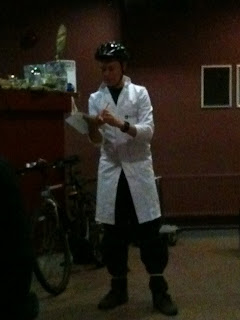
An excellent evening in the "Disco Bar" (as it was) but "Escape Bar" (as it is) with friends and colleagues from across the teams in Learner Support Services. The pub quiz by the re-formed "two idiots" was fantastic and Professor Davis and his chemistry experiments will no doubt be remembered for years to come - especially the one requiring health and safety approval. The toast eating contest was also memorable for various reasons. But the biggest laugh of the evening was later on at home watching the comedy series "Life's Too Short" when Warwick fly tipped his brand new washing machine. Absolutely Epic!


Wednesday, 14 December 2011
Deck the halls
Shamefully cut and paste from an internal circulation but worthy of viral marketing. Here is a nice way to spend a few minutes in a University setting - which looks a lot like the Atrium/Student Central here at Bradford. From original message:
The halls of the Carlson School of Business are bustling these days with students preparing for their upcoming finals. Recently, those same halls were filled with "merry measure" when all received a surprise visit from a saxophonist and about 300 of his friends.
View Holiday Card
The halls of the Carlson School of Business are bustling these days with students preparing for their upcoming finals. Recently, those same halls were filled with "merry measure" when all received a surprise visit from a saxophonist and about 300 of his friends.
View Holiday Card
Thursday, 8 December 2011
IT "at risk" dates
We are currently reviewing our process of established IT "at risk" dates during the year which are published well in advance (currently out to January 2014) and which allow fixed dates in the University Calendar for IT related service interruptions. I believe that we are quite unusual in having this particular luxury embedded in our culture and so far supported (although sometimes a little reluctantly) by the University management. Some of them would prefer out of hours evening and weekend working usually during holiday periods i.e. holiday for the rest of the University in terms of the academic calendar. The options we are considering include "Do Nothing" and stay with three periods a year, moving to more frequent calendar but less days "at risk" in each period and less days overall too. Third option is moving to a more ad hoc arrangement, particularly for high impact services or new projects, perhaps mixed with the second option ie a hybrid approach. One thing we might need to think about is the label - is "risk" the right word? perhaps it should be the IT "opportunity" dates or "improving your IT Services" dates because the work is often about addressing a risk through maintenance and housekeeping of systems. comments welcome.
Monday, 5 December 2011
Snow Plough ready for (immediate) action
Almost one year to the day it snowed very heavily on the way to work this morning. A thick heavy coating of snow on untreated roads in Bradford led to ice rink conditions not helped by generally poor driving by commuters unable to manage the conditions. This week is degree ceremonies week so its the anniversary of last year's closure and I believe that the trigger for all this weather is the purchase and delivery last week of a brand new snow plough, gritter and tractor which arrived on the lowloader for immediate use! Here it is:


Friday, 2 December 2011
Disappearing teaspoons
This morning there wasn't a teaspoon to be seen in the staff room or on my shelf. So I put a sign up on the wall saying: "please bring back the disappearing teaspoons". This evening a learned colleague in the Library told me about this BMJ article on the disappearing teaspoon so here is an abstract and a link. So we are not the only ones affected, but could you make a career out of it?
Abstract
Objectives To determine the overall rate of loss of workplace teaspoons and whether attrition and displacement are correlated with the relative value of the teaspoons or type of tearoom.
Design Longitudinal cohort study.
Setting Research institute employing about 140 people.
Subjects 70 discreetly numbered teaspoons placed in tearooms around the institute and observed weekly over five months.
Main outcome measures Incidence of teaspoon loss per 100 teaspoon years and teaspoon half life.
Results 56 (80%) of the 70 teaspoons disappeared during the study. The half life of the teaspoons was 81 days. The half life of teaspoons in communal tearooms (42 days) was significantly shorter than for those in rooms associated with particular research groups (77 days). The rate of loss was not influenced by the teaspoons' value. The incidence of teaspoon loss over the period of observation was 360.62 per 100 teaspoon years. At this rate, an estimated 250 teaspoons would need to be purchased annually to maintain a practical institute-wide population of 70 teaspoons.
Conclusions The loss of workplace teaspoons was rapid, showing that their availability, and hence office culture in general, is constantly threatened.
Abstract
Objectives To determine the overall rate of loss of workplace teaspoons and whether attrition and displacement are correlated with the relative value of the teaspoons or type of tearoom.
Design Longitudinal cohort study.
Setting Research institute employing about 140 people.
Subjects 70 discreetly numbered teaspoons placed in tearooms around the institute and observed weekly over five months.
Main outcome measures Incidence of teaspoon loss per 100 teaspoon years and teaspoon half life.
Results 56 (80%) of the 70 teaspoons disappeared during the study. The half life of the teaspoons was 81 days. The half life of teaspoons in communal tearooms (42 days) was significantly shorter than for those in rooms associated with particular research groups (77 days). The rate of loss was not influenced by the teaspoons' value. The incidence of teaspoon loss over the period of observation was 360.62 per 100 teaspoon years. At this rate, an estimated 250 teaspoons would need to be purchased annually to maintain a practical institute-wide population of 70 teaspoons.
Conclusions The loss of workplace teaspoons was rapid, showing that their availability, and hence office culture in general, is constantly threatened.
Subscribe to:
Posts (Atom)